Kirk Gibson
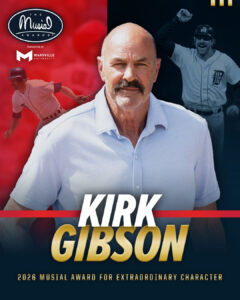
The Musial Award for Extraordinary Character is one of two special honors bestowed at the Musial Awards. It recognizes an individual who demonstrates remarkable class, perseverance and overall sportsmanship.
Despite a torn left hamstring and strained right knee, Kirk Gibson created an iconic World Series moment. Limping to the plate with two outs in the bottom of the ninth in the first game of the 1988 Series, his Dodgers trailed Oakland 4-3. With a man on second, Kirk fouled off pitch after pitch with two strikes until finally lifting the ball out of Dodger Stadium for a 5-4 victory. He fist-pumped and jogged deliberately around the bases to Jack Buck’s immortal call: “I don’t believe what I just saw.”
Believe it. And so much more. Because we hadn’t seen nothin’ yet.
The hamstring and knee healed; the ailments that slow him today have no cure. Yet when Parkinson’s disease tried to claim his passion and vigor, Kirk found the determination to dig even deeper, making life better not just for himself but for all who suffer from the disease.
“I was an average athlete who did some good things at the right time,” he says, but now, “I want to be somebody that can provide hope for those who need it.”
Kirk initially gained notoriety, not all of it positive, as a multisport unicorn: an All-American wide receiver at Michigan State University and a draft pick by the Detroit Tigers. By his own admission, he was “pretty cocky” and had trouble transitioning from a fiery competitor on the field to “this nice person” off the field.
The values that Stan Musial embodied emerged gradually. He started to pay it forward as a manager, taking a young Paul Goldschmidt under his wing. “He was such a smart ballplayer,” Paul says. “(People) thought he was like this old-school, hard-nosed guy. But he taught me so much early on in my career.”
Kirk forged successful moves from the dugout to the broadcast booth but faced his most challenging transition in 2015. He was diagnosed with Parkinson’s, a degenerative disorder of the nervous system that causes tremors, stiffness and problems with movement and balance. Ever the fighter, though, he faced the challenge head-on.
“To win your World Series,” he says, “you must be willing to change your own picture of who you are today. I found the will to change my picture, and it transformed my life.”
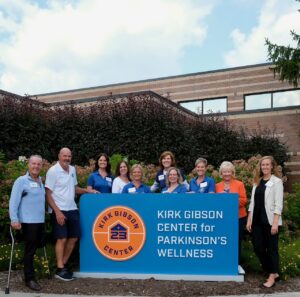
Fighting the disease for himself and others became his new World Series. Instead of searching for a cure, though, Kirk has focused on quality of life. Through his foundation, he established the Kirk Gibson Center for Parkinson’s Wellness in Farmington Hills, Michigan. Opened in August 2025, the center is free for one and all and includes spaces for therapy, socializing and developing a sense of community for people with the disease and their care partners. Kirk not only has raised more than $30 million for the center, but he is present to share his struggles and triumphs with more than 3,000 people he considers his new teammates.
“You get the buy-in, and you imprint the good things,” he says. “That’s where the magic comes.”
His struggles have also led to a born-again zeal for humility and generosity. He offered this advice in a commencement speech at his alma mater: “Remain humble, and always treat others with kindness and respect. A harsh comment can hurt another person, but a kind word can produce amazing things.”
Though Parkinsons has muted some of his personal bravado, his passion and action for others has grown more impactful every day. But the journey is far from over.
“We try to stay true to our mission and help as many people as we can discover their quality of life,” he says. “Because every step that you take, every battle that you fight, every day, there’s more to be done.”