Carson Pickett
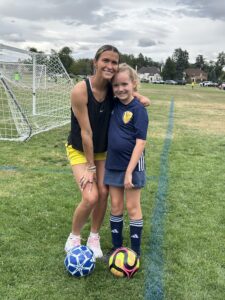
Carson Pickett has learned and lived the paradox that being different can be oh, so beautiful yet oh, so normal − at the same time. Now, she shares the message, making the soccer world − and beyond − a more welcoming place.
Born without her left arm from the elbow down, Carson – a member of the Denver Summit of the National Women’s Soccer League – grew to accept, then celebrate what seemed like a liability, and has become a role model to others.
Before sharing empathy, kindness and compassion, though, she leaned on those virtues from her parents, Mike and Treasure Pickett. Mike was her first soccer coach, who urged her to “never let anyone turn your sky into a ceiling.” Soccer became a refuge “because I didn’t ever feel isolated,” she says, knowing that teammates “would always stick up for me if anyone said anything.”
Her goal was to be just one of the gang, standing in the middle of team photos to hide her arm yet doing “so much more than everyone else… to show my worth.” Describing her extra motivation, she explains, “I wanted to make teams and get scholarships, all because of my athletic ability. I didn’t want to be known as a girl with one arm to play soccer.”
She fulfilled that dream at Florida State, winning the 2014 NCAA Championship. The moment, however, offered both a professional and personal crossroads, when she could no longer avoid the obvious questions about her difference. A tearful Carson sought solace from her mom, who Carson says presented her with two options: “You can either use the platform God gave you, or you can just be selfish and kind of go the opposite way.’”
Carson’s pro career has spanned 11 seasons in the NWSL, and she became the first player with a limb difference to play for the U.S. Women’s National Team. But her inner advocate really blossomed earlier this year, when the team’s media staff arranged a meeting with a fan, Hayden Stine, born without much of her right arm.
“I could just see it in her face, like a breath of fresh air being like, ‘Wow. I have someone I can look up to who looks like me,’” Carson says. “I never had that growing up. So I can imagine that was a really good feeling to know that she can achieve all her dreams, even if she looks different.”
Posing for a photo, Carson asked Hayden to raise her arm. “She put up her normal arm, and I was like, ‘No, no, your other one. We’re the same.’” It’s hard to say, though, whether that moment of solidarity and empathy was more transformative for Carson or Hayden.
Since bonding with Carson, Hayden dreams big, hoping to play professional soccer. “Role models make you feel like you can do anything – just like them,” she told CBS News. When her time comes to be a role model, Hayden says she’ll be “up for it.”

Carson popped in for one of Hayden’s games and practices. The similarity in their difference opened the door, she says, “But I hope that I’m showing her so much more, and just being a good human.”
To that end, Carson has partnered with Hand Camp Colorado by hosting youth soccer training sessions and greeting kids with physical differences at every one of the Summit’s games.
“People get so nervous to talk to us,” Carson says. “So, I just hope that it shows that, again, we’re human beings, and we go through everything that everyone else goes through and that we’re never too big to be kind to people.”
A sentiment that’s different, beautiful and normal – all at the same time.