Billie Jean King
 By Kathleen Nelson | Musial Awards Program Contributing Writer
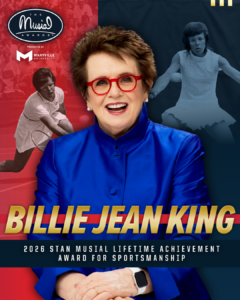
The Stan Musial Lifetime Achievement Award for Sportsmanship is the pinnacle honor bestowed at the Musial Awards. It recognizes iconic sports figures who exemplify sportsmanship and embody the class, dignity, generosity, excellence, civility and integrity for which Stan the Man was known.
On a macro level, Billie Jean King’s advocacy and influence seem capable of moving mountains. You could argue that she has been more successful than any individual in advancing equality, fairness and opportunity for all, especially in sports. Equally important, however, she exerts her influence on the micro level, touching individuals and inspiring them to carry the torch. Me included.
Before she could champion the cause of equality, Billie Jean honed her gravitas as a champion on the court.
- 39 Grand Slam singles, doubles and mixed doubles titles
- 20 Wimbledon championships (a record)
- 6 times ranked year-end No. 1
- 7-time winner of the Fed Cup, the women’s equivalent of Davis Cup. She was so successful that the trophy was renamed for her.
In the midst of this, she conquered a made-for-TV spectacle sorely lacking in gravitas, facing Bobby Riggs in the “Battle of the Sexes.” I watched with my dad and 90 million other viewers in 1973. I’m not sure that he wanted to see Billie Jean win. But, just maybe, he wanted me to see Billie Jean win. Her victory freed a piece of my 14-year-old soul, convincing me that women could do so much more than others envision for them.
Almost simultaneously, she founded the Women’s Tennis Association, achieving equal prize money for women at the U.S. Open. She established the Women’s Sports Foundation to protect the gains of Title IX and provide access to girls and women in sports. She also co-founded World Team Tennis (WTT), which featured the first professional co-ed teams competing together. For more than a half-century, each has deepened and widened the growth of women in sports.
Maybe more important, she has used her one-on-one charisma to anoint keepers of the flame, spreading the message of equality to other sports and other causes. Among her ambassadors of fairness are Chris Evert and the Williams sisters in tennis, Julie Foudy in soccer and Kendall Coyne Schofield in hockey.
I’m humbled to have benefited from her personal touch as well. I covered the Aces, St. Louis’s entry in WTT, which meant I occasionally interviewed Billie Jean. In those moments, she channeled traits that served Stan Musial so well: empathy and kindness. Time stood still during our conversations, seemingly for her as much as me. She always asked about me, never in a hurry.
And she remembered. I covered her appearance to commemorate an anniversary of the Battle of the Sexes. In the midst of explaining its significance, she spotted me taking notes in the back of the room. “Kathleen will back me up on this, right?” she said, as all eyes turned to me. Stunned that she remembered, or was reminded of, my name, I managed to wave, nod and give a thumbs up.
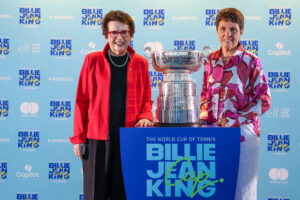
A few years later, she met the editors of my employer, the St. Louis Post-Dispatch, to make a pitch not only for tennis but for women’s sports. ”Kathleen, you’re a runner,” she started. I had forgotten that we discussed my hobbies and can’t recall what she said after that. She brought it up, I believe intentionally, to show the others in the room that she saw value not just in Team Tennis and women in sports, but maybe in me.
That wink and a nod empowered me to bolster the courage of my convictions. Since then, several editors at the Post and colleagues with the Musial Awards have referred to me as “the conscience of the group.” I’m not sure I would have spoken my mind or stood up for my truth as often without that Billie Jean – or was it a Musial – moment.
So, thank you and congratulations, Billie Jean, for your impact great and small.